In this article
- 1. Put drawers under the bed
- 2. Choose a storage ottoman
- 3. Hang organizers over doors
- 4. Shelve the corners
- 5. Use the inside of closet doors
- 6. Raise the bed on risers
- 7. Mount shallow wall cabinets
- 8. Add a storage bench at the foot of the bed
- 9. Roll in a slim cart
- 10. Compress off-season textiles with vacuum bags
- 11. Hang a pegboard for tools and gear
- 12. Choose a sofa with built-in storage
- 13. Store above the kitchen cabinets
- 14. Swap in nesting tables
- 15. Use a trunk as a coffee table
- 16. Mount a fold-down wall desk
- 17. Declutter before you store
- How to Plan Storage for a Small Room
- Small Room Storage Mistakes to Avoid
- Choosing Your First Three
The best storage ideas for small rooms share one trait: they use space the room was wasting anyway. Under the bed, inside the ottoman, behind the door, up the wall. None of these ideas ask for more square footage, and most cost less than a single new dresser. Here are 17, ranked roughly by impact, with honest notes on what each one demands from you.
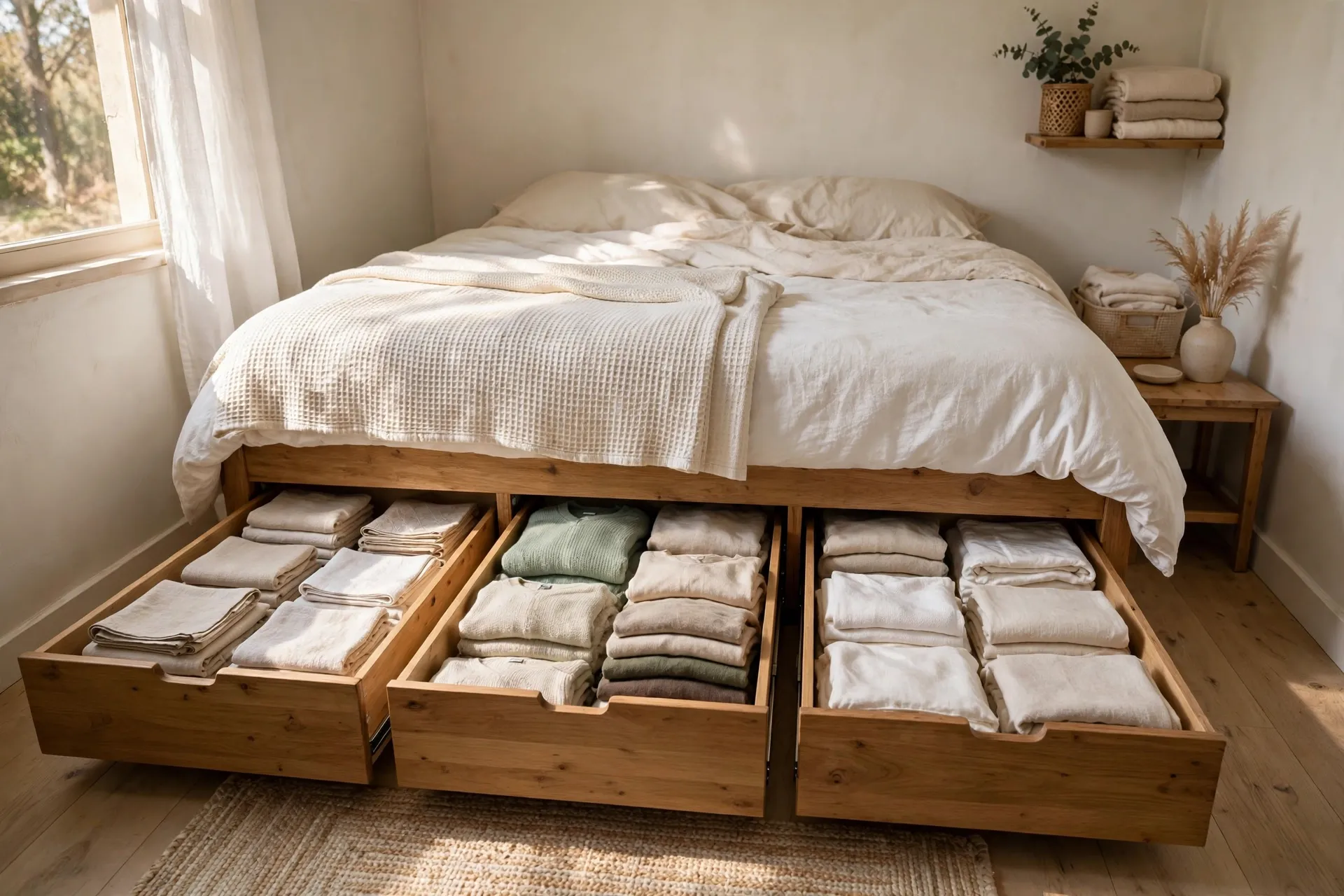
1. Put drawers under the bed
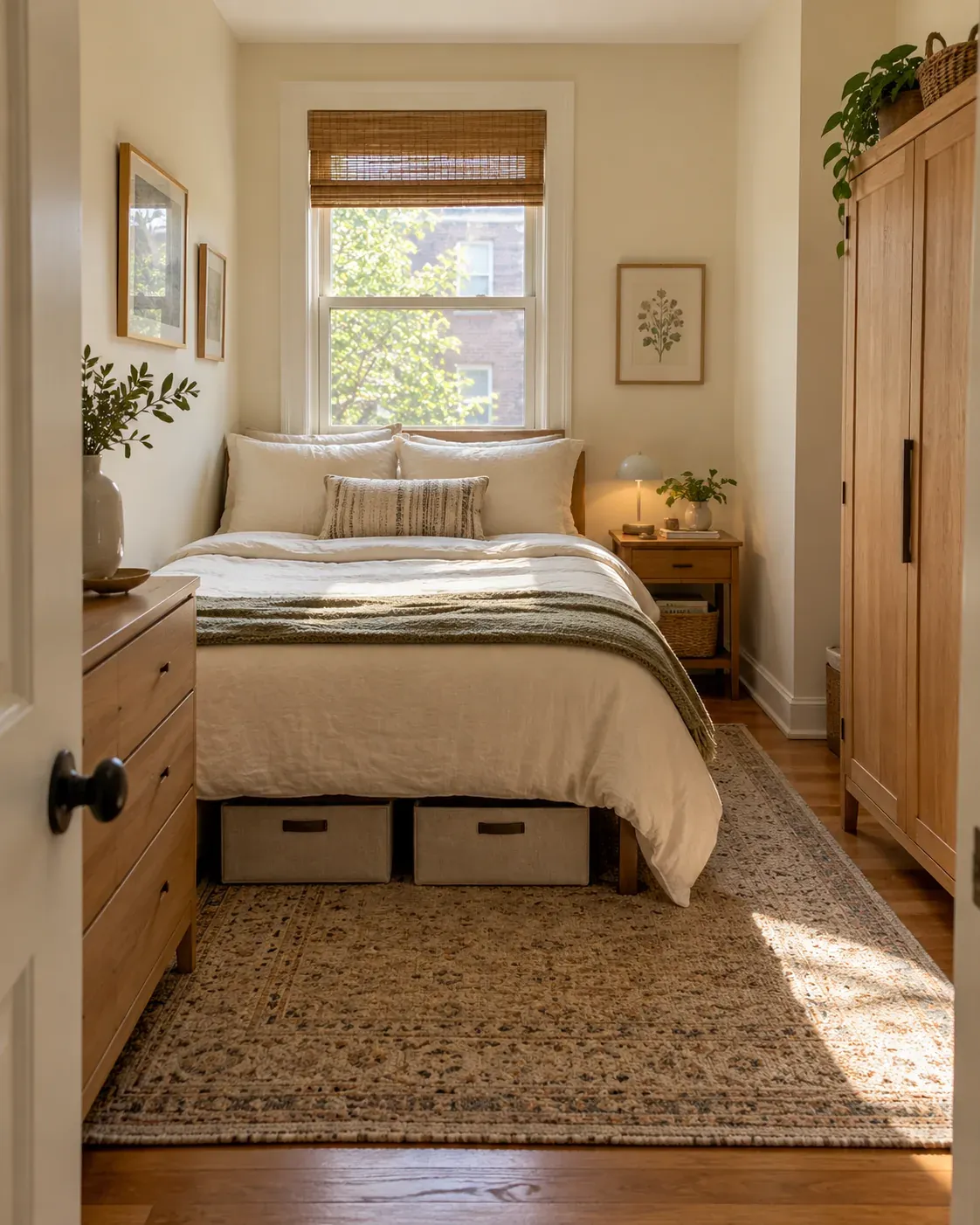
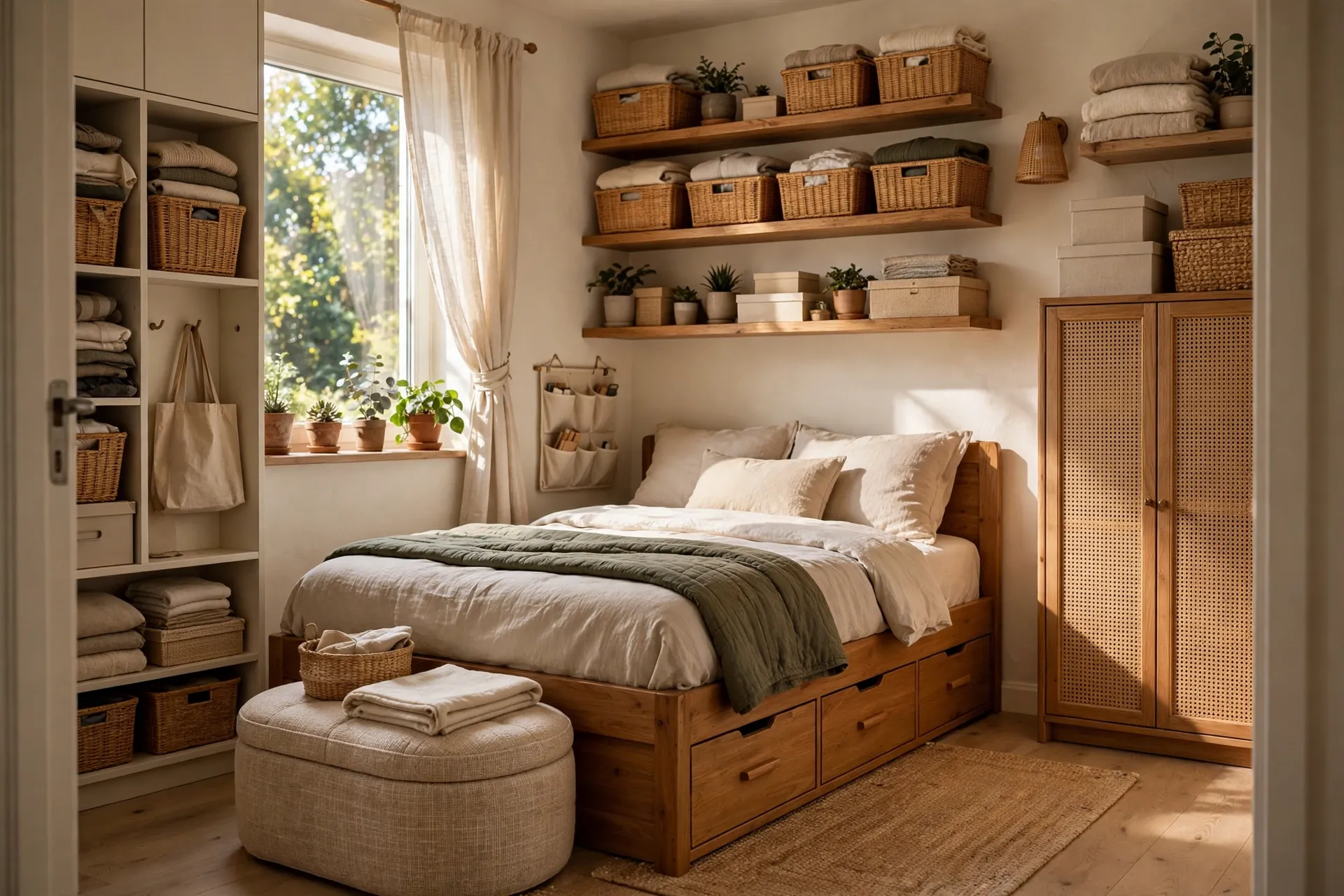
The space under a bed is the largest unused volume in most small rooms, and drawers convert it into a dresser. Purpose-built under-bed drawers on glides pull out smoothly and look intentional; flat bins are cheaper but harder to access. A queen bed offers roughly 30 cubic feet down there, enough for off-season clothes, linens and shoes.
Measure your bed frame’s clearance before buying anything. Standard frames give 7 to 10 inches; platform beds may give almost none. Drawers need the full clearance plus glide space, so bins suit lower frames better. Whatever you choose, this storage only works if you can open it without moving furniture, so keep the bedside clear.
2. Choose a storage ottoman
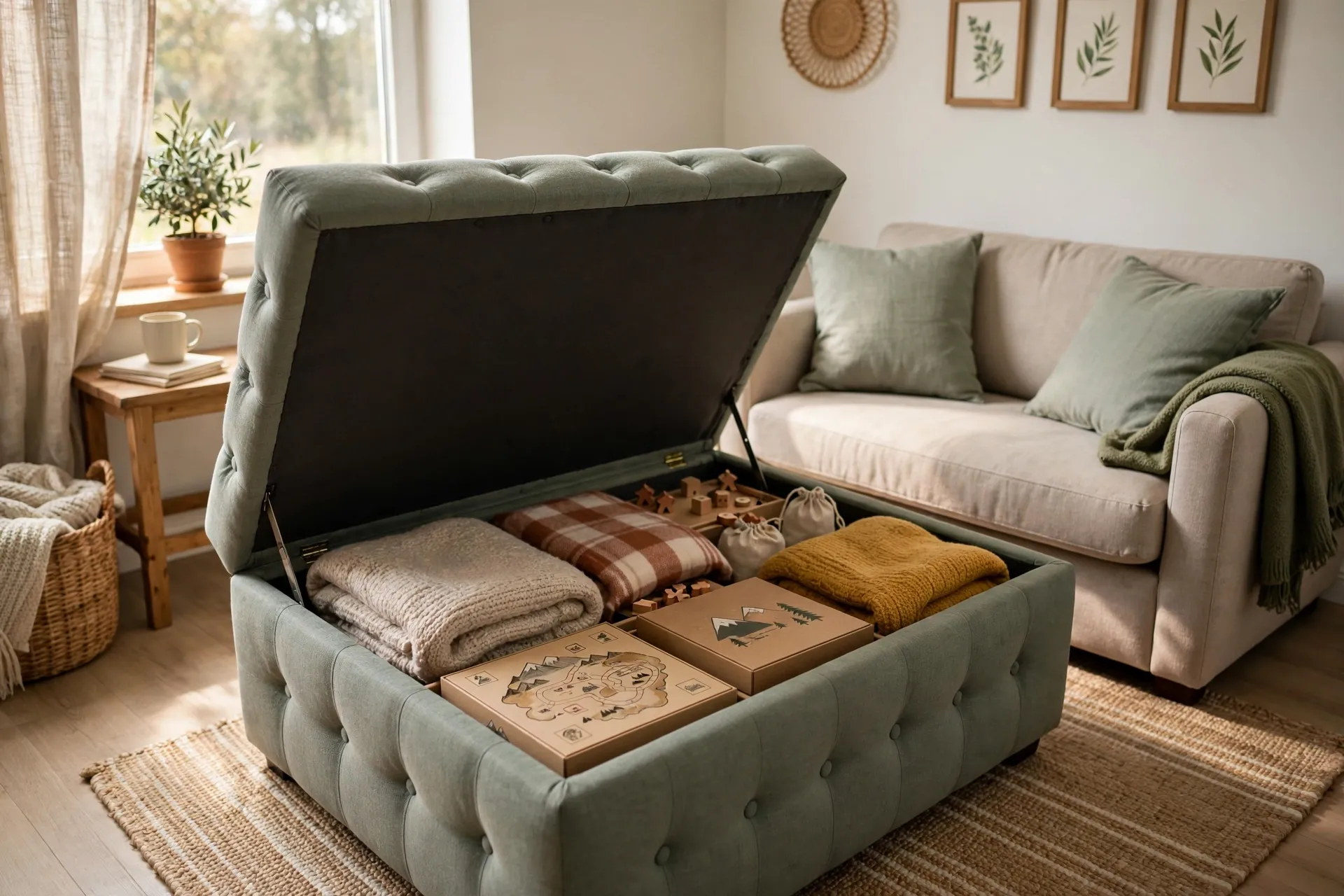
A storage ottoman is three pieces of furniture in one footprint: footrest, extra seat and blanket chest. In a small living room or bedroom it holds throws, board games, wrapping supplies or kids’ toys, all retrievable with one hand. Hinged lids that stay open on their own are worth seeking out; lids that slam shut get left closed.
Size it to the seating: the ottoman should be roughly two-thirds the width of the sofa and sit 1 to 2 inches lower than the seat height for comfortable footrest use. A tray on top converts it to a coffee table in seconds. The only real downside is that deep ottomans become archaeology digs, so add a small bin inside for the little things.
3. Hang organizers over doors
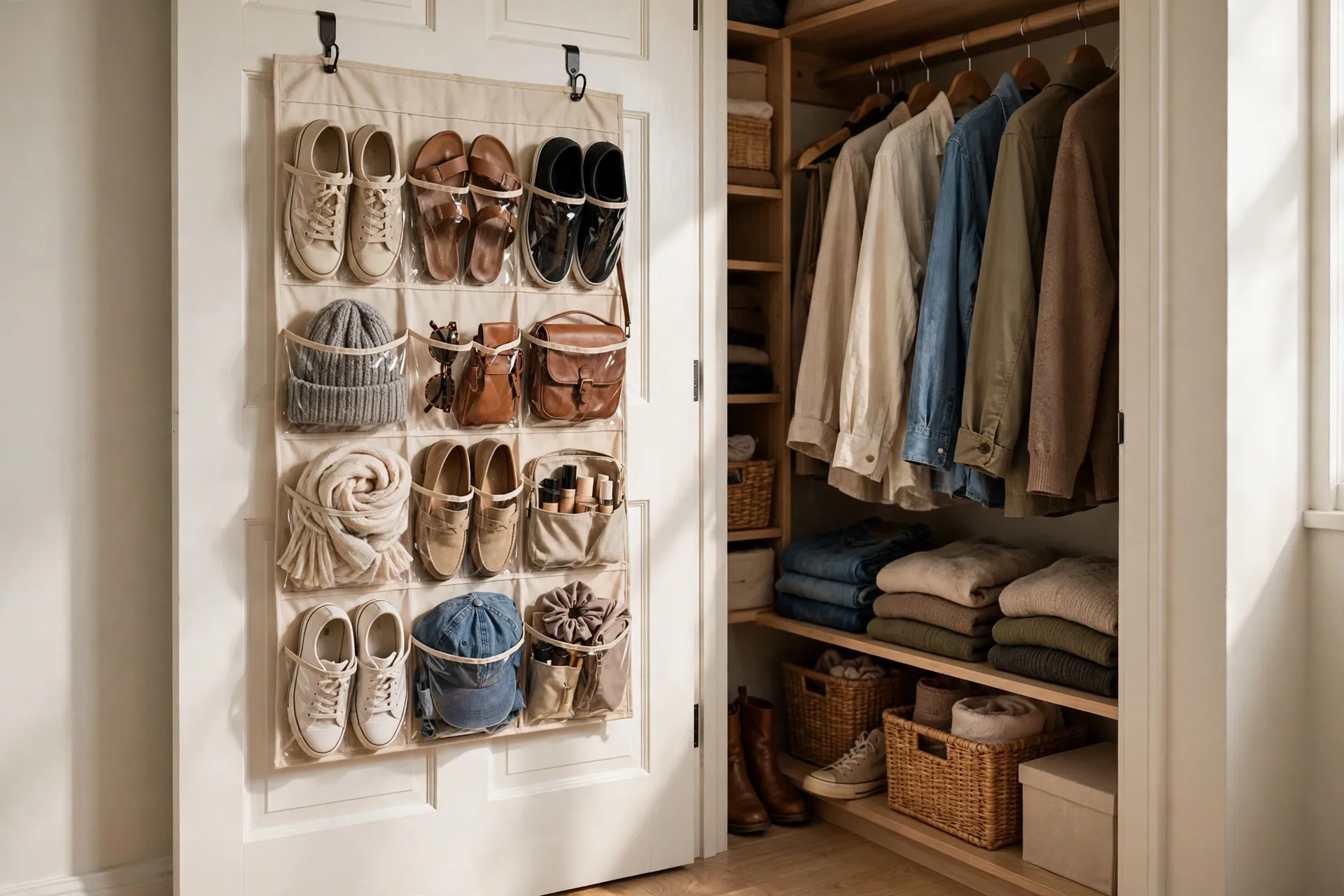
Over-door organizers add a whole closet’s worth of pockets without a single screw, which makes them the renter’s best friend. Shoe organizers work for more than shoes: cleaning supplies, pantry items, craft materials, toiletries. Hang them on bedroom, closet and pantry doors, anywhere with clearance.
Check the door’s closing clearance first, since thick organizers prevent latching. Felt pads behind the hooks protect the door finish, which matters for your deposit. And be selective: an over-door organizer on every door in a small room looks chaotic. One or two, in closed rooms, is the sweet spot.
4. Shelve the corners
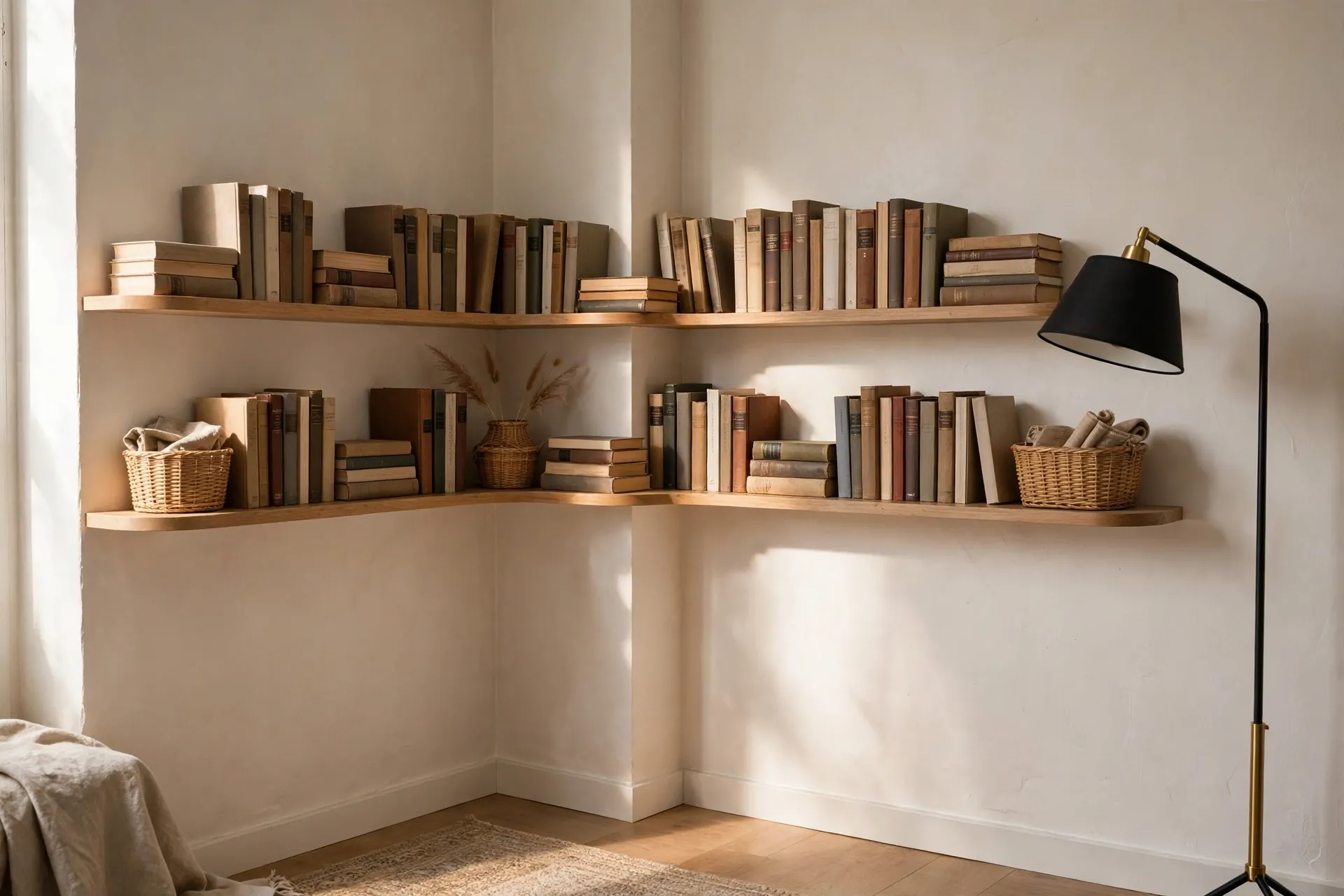
Corners are the most wasted space in small rooms, and wraparound corner shelves reclaim them for books, plants and baskets. Floating corner shelves need no floor space at all; a corner bookcase uses about two square feet for five tiers of storage. Either way, the corner stops being dead space.
Corner shelves suit light and medium items best. Heavy books belong on shelves anchored into studs on both walls, which is doable but fiddly. Keep corner styling simple: a stack of books, a plant, a basket, repeated with variation. Crammed corner shelves read as clutter faster than any other shelf because the corner traps the eye.
5. Use the inside of closet doors
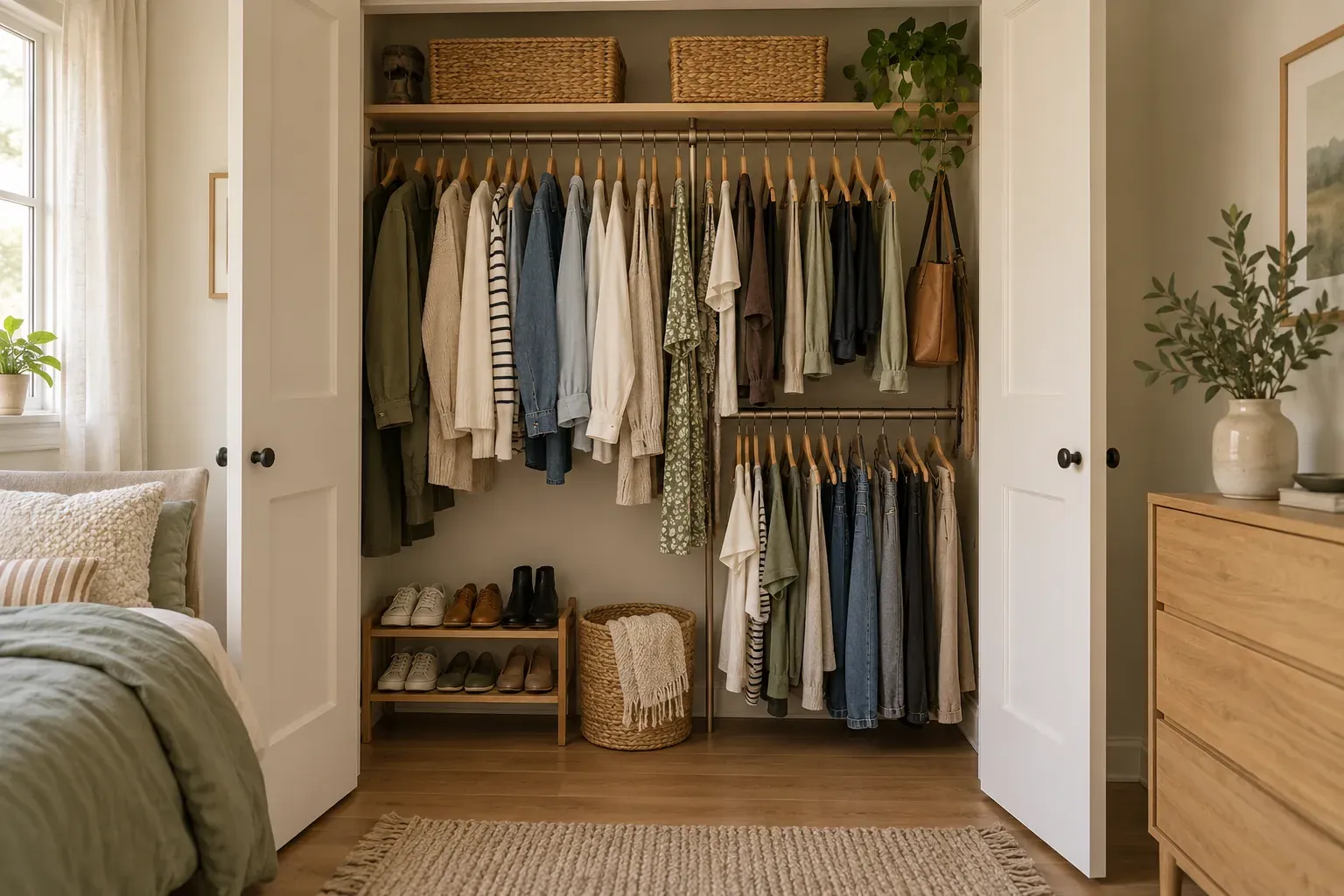
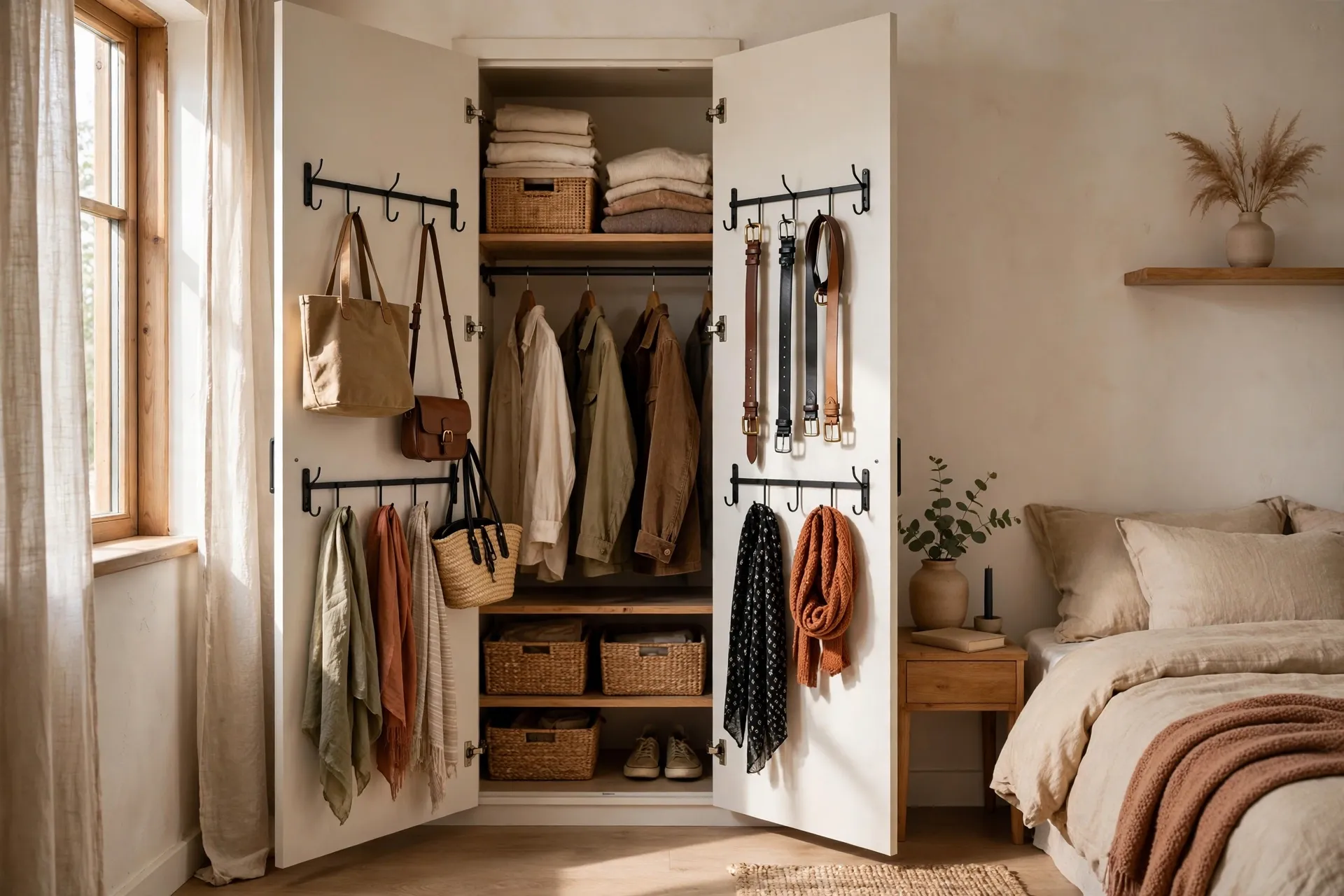
The inside face of a closet door is a narrow, full-height storage wall most people ignore. Slim racks, hooks and pocket organizers mounted there hold belts, scarves, bags, jewelry and ties, all invisible when the door closes. This is genuinely free space: it costs nothing in floor area and barely anything in dollars.
Keep additions slim, under 4 inches deep, or the door will not close. Over-door hooks that grip the top need no screws and leave no marks, the ideal renter solution. For reach-in closets with sliding doors there is no inside face, so this idea belongs to hinged-door closets; sliding-door owners should look at the wall beside the closet instead.
6. Raise the bed on risers
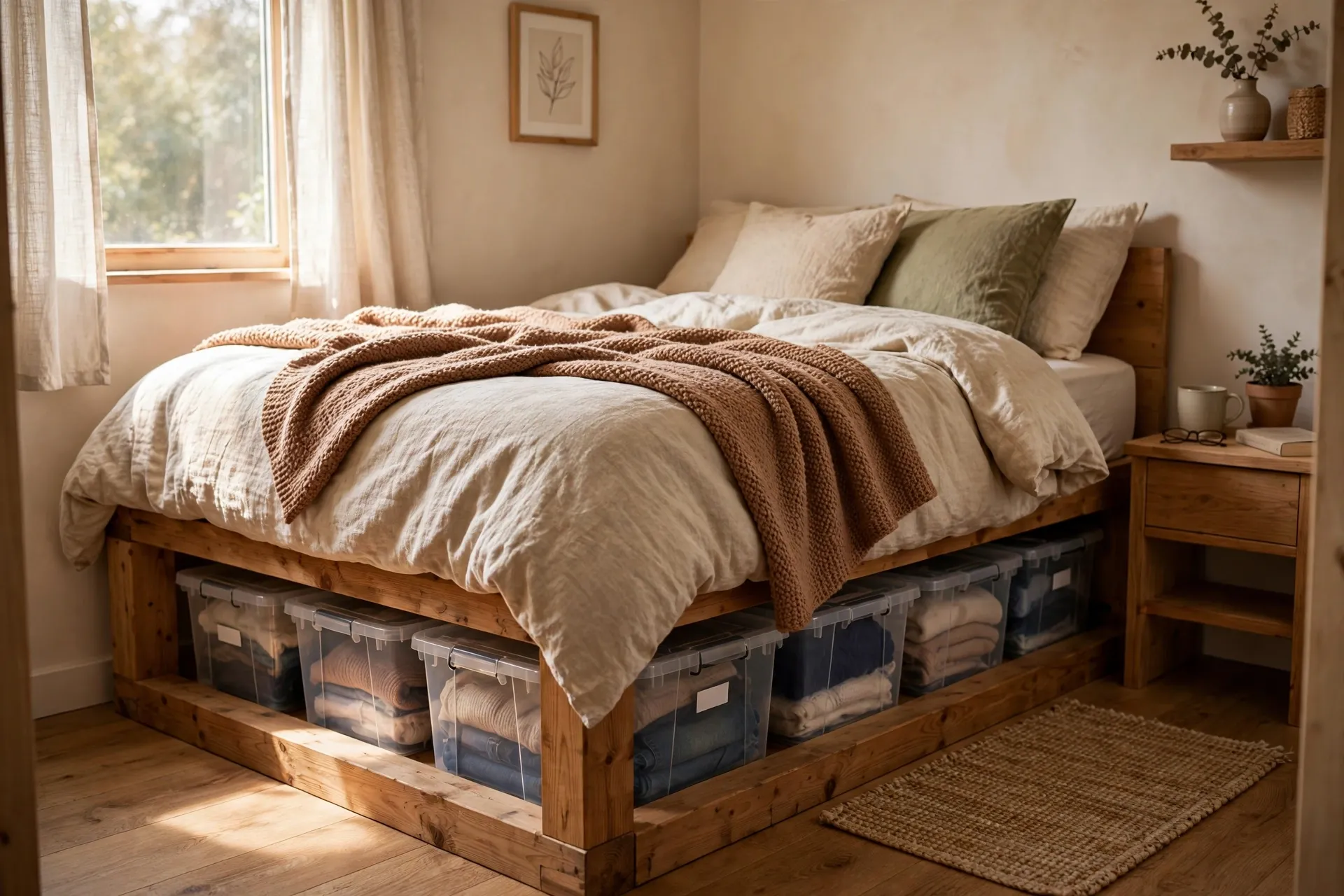
Bed risers are the cheapest storage upgrade in this list, often under $30 for a set. They lift a standard frame 5 to 8 inches, creating clearance for flat bins, suitcases and the box of things you rarely need but cannot discard. Sturdy wood or steel risers handle the weight; cheap plastic ones crack and tilt.
The tradeoff is bed height. A raised bed can feel too tall, especially with a thick mattress, making getting in and out awkward for shorter people or anyone with knee trouble. Total sleeping height over 30 inches deserves a second thought. Also check that the risers fit your bedpost shape; round posts need cup-style risers, square posts need square ones.
7. Mount shallow wall cabinets
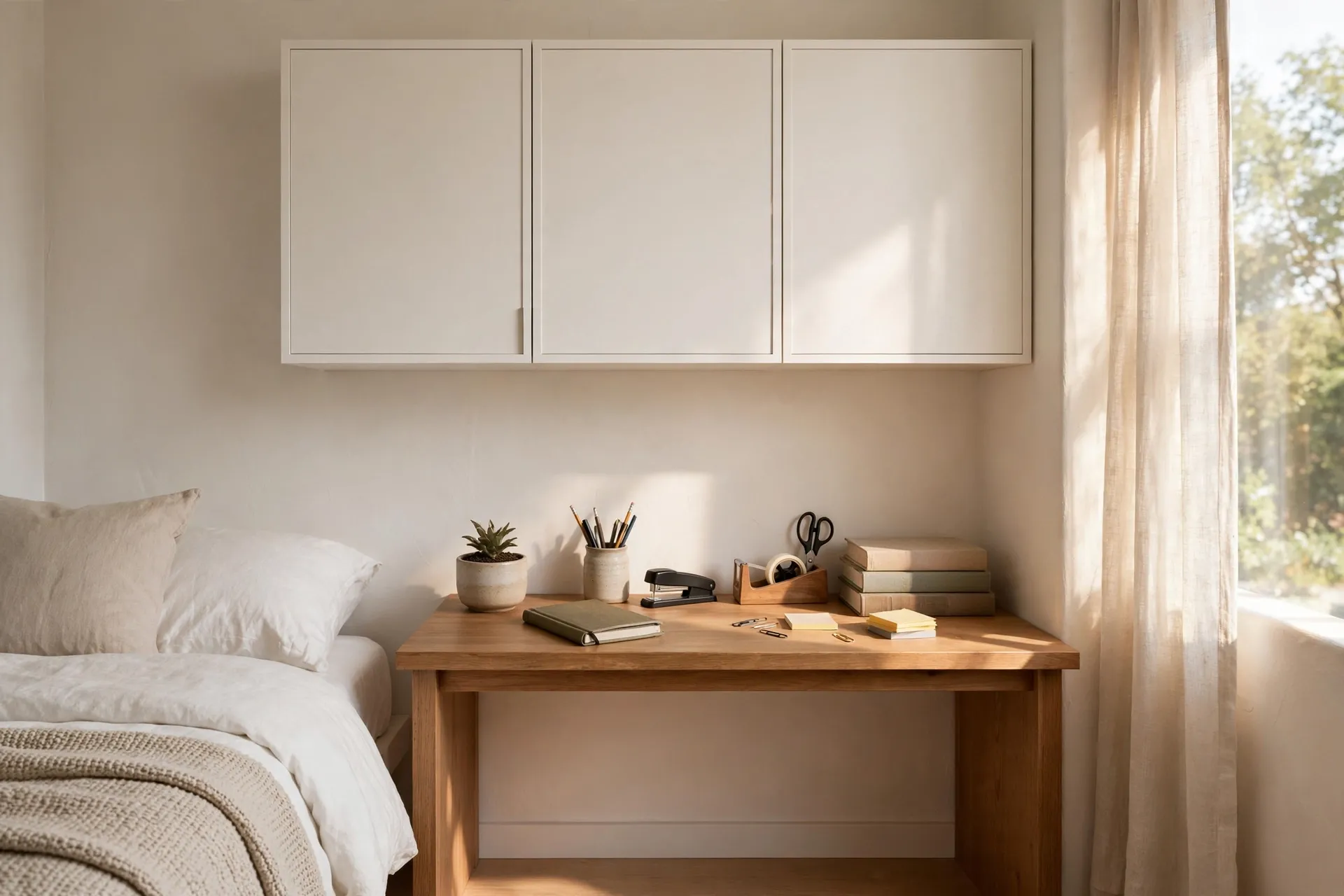
Shallow wall cabinets, 8 to 12 inches deep, add closed storage without touching the floor plan. Above a desk they hold office supplies; in a bedroom they replace a nightstand’s worth of clutter; in a small dining area they hide the table linens. Closed doors mean no styling required, which is a mercy in a busy room.
Mount into studs or use heavy-duty drywall anchors, because even shallow cabinets get heavy when loaded. Keep the bottom of the cabinet at least 18 inches above any surface below it so you can actually use that surface. One long cabinet usually looks calmer than three small ones scattered on the same wall.
8. Add a storage bench at the foot of the bed
A bench at the foot of the bed stores off-season bedding, extra pillows and the clothes you tried on and rejected, while giving you a place to sit while dressing. Choose one with a lift-up lid or deep drawers rather than an open bench; open benches become clutter shelves within weeks.
The bench should be slightly narrower than the bed and no taller than the mattress top, or it looks like a barricade. In very small bedrooms, skip the bench and put that storage in the ottoman or under-bed drawers instead; a bench needs about 18 inches of clear floor in front of the bed to be usable.
9. Roll in a slim cart
A narrow rolling cart, 6 to 8 inches wide, slides into gaps that nothing else fits: between the fridge and the wall, beside the dresser, next to the desk. Use it for the categories that migrate around the room: art supplies, medications, charging gear, cleaning products. The wheels mean it can move to where the work is happening.
Carts only work if the gap is truly accessible. Measure the narrowest point, including baseboards and door trim, and buy the cart to fit with an inch to spare. A cart that has to be wrestled out of its gap will stay parked forever, becoming just another dusty shelf.
10. Compress off-season textiles with vacuum bags
Vacuum-sealed bags shrink bulky winter bedding and coats to a third of their volume, which can free an entire shelf or bin. They are the highest-impact-per-dollar storage product for small rooms with real seasons. Buy bags with a double-zip seal and a reliable valve; cheap single-zip bags slowly reinflate.
Do not vacuum-seal anything with down or delicate fibers for more than a season, since prolonged compression damages loft. And store sealed bags where they will not puncture: under-bed is ideal, a garage floor with nails is not. Label every bag, because a stack of identical flat bags is impossible to search.
11. Hang a pegboard for tools and gear
A pegboard turns a wall into endlessly reconfigurable storage for craft supplies, tools, jewelry or desk accessories. Hooks, shelves and bins rearrange in seconds as needs change, which fixed shelving cannot match. A 2x4-foot pegboard holds a surprising amount and costs little.
Pegboards look busy by nature, so confine them to work zones: craft corners, home offices, utility walls. In a bedroom or living room, a pegboard becomes the visual focus whether you want it or not. Paint it the wall color to quiet it down, and frame it with simple trim so it reads as intentional rather than workshop-y.
12. Choose a sofa with built-in storage
Storage sofas hide a chaise compartment or under-seat space big enough for guest bedding, board games or the vacuum’s attachments. In a small living room, the sofa is the largest footprint after the bed, so making it store is high leverage. Sectionals with storage chaises are especially generous.
Test the mechanism in person if you can. Storage compartments with flimsy hinges or lids that require two hands and a cleared seat do not get used. The best designs open with one hand and stay open on their own. Expect to pay a few hundred more than a comparable non-storage sofa; the cost per cubic foot is still excellent.
13. Store above the kitchen cabinets
The gap above wall cabinets is dusty dead space that fits surprisingly useful things: the rarely used stand mixer, bulk pantry overflow, the vase collection. Baskets or bins up there keep it tidy and make retrieval a planned event rather than a daily reach. This is bonus storage, not working storage.
Clean it twice a year, because kitchen grease settles on everything up there. Line the cabinet tops with a washable mat or old sheet for easy cleaning. Do not store anything you need weekly; if you are climbing for it regularly, it belongs somewhere reachable and something else belongs up top.
14. Swap in nesting tables
Nesting tables give you three surfaces in one table’s footprint. Pulled apart, they serve guests on the sofa, hold a laptop and coffee, or flank a reading chair; nested, they occupy no more floor than a single side table. They are the small-room answer to the coffee table versus side table debate: you get both.
Choose sets where the smallest table actually fits under the largest with clearance to spare, and where each table is sturdy enough to hold a drink without wobbling. Glass or light wood tops keep the set visually light. Avoid sets where the tables only nest in one fussy order; you will never bother.
15. Use a trunk as a coffee table
A trunk or large lidded chest as a coffee table stores blankets, games and the remote controls while serving as a surface and extra seat. Vintage trunks bring character; new storage chests bring soft-close lids and safer hinges. Either way, it is the highest-capacity coffee table possible.
Check the height: trunk coffee tables run 16 to 20 inches tall, and anything over 18 inches feels too high next to a standard sofa. Add felt pads underneath to protect floors, and be cautious with antique trunks around small children, since old lids can slam. A tray on top keeps the surface usable for drinks.
16. Mount a fold-down wall desk
A wall-mounted drop-leaf desk gives you a real work surface that vanishes when the workday ends. Folded up it is a shallow cabinet, 6 to 8 inches deep; folded down it is a 20-inch-deep desk. For small rooms that double as home offices, this is the difference between a room that works and a room dominated by a desk.
Mount into studs, full stop. A desk cantilevered off drywall anchors will fail, possibly with your laptop on it. Keep the desktop clear-ish so folding it up is a ten-second job, not a relocation project. Pair it with a chair that tucks elsewhere, or the freed floor space is theoretical. Our small closet organization ideas cover the same fold-away thinking for wardrobes.
17. Declutter before you store
The unglamorous truth: the cheapest storage is needing less of it. Before buying a single bin, pull everything out of the room’s problem area and sort ruthlessly. In our experience, small rooms typically surrender 20 to 30 percent of their stored volume to things that are broken, duplicated or kept from guilt. Those things were paying rent in your square footage.
Do this one category at a time, not one overwhelming whole-room purge. Finish clothes before starting books. And set a rule for what comes back in: one in, one out for the categories that grow fastest. Storage systems fail when inflow never stops; no bin survives a shopping habit.
How to Plan Storage for a Small Room
Walk the room and list what has no home: the things on the floor, the chair, the counter. Those homeless items define your storage brief better than any catalog. Then assign each category to one of the ideas above based on how often you touch it: daily items at hand height and open, weekly items at eye level, seasonal items high or under the bed.
Buy in the order of pain. The thing that bothers you every morning gets solved first; the theoretical future need waits. And measure twice for every piece: the gap, the door swing, the reach. Small rooms punish approximate measurements because there is no slack to absorb them. A bin that is half an inch too wide for the gap is a return trip.
Small Room Storage Mistakes to Avoid
The biggest mistake is buying storage before decluttering, which just organizes things you do not need into prettier containers. The second is choosing open storage for ugly necessities: cleaning supplies, medications and cables need doors, not display shelves. The third is blocking the room’s function with its storage: the under-bed drawers you cannot open because the nightstand is in the way, the closet door organizer that prevents the door closing.
Watch the visual weight too. Floor-to-ceiling storage on every wall makes a small room feel like a stockroom, however tidy. Leave at least one wall calm, and mix closed storage with open. Storage should quiet a room, not fill it. And if you paint those walls a deep, enveloping color, storage pieces recede beautifully; see our guide to moody paint colors that work in small rooms for how dark walls change the equation.
Choosing Your First Three
If the whole list feels like a lot, start with the three highest-impact moves: under-bed drawers, a storage ottoman, and one over-door organizer. Together they add the equivalent of a dresser and a closet shelf for a few hundred dollars and zero floor space. Live with those for a month, notice what is still homeless, then pick the next idea that matches the actual problem.
Small rooms do not need more stuff; they need the right stuff in the right hidden places. And when the dining corner needs the same treatment, a table with drawers or a drop leaf keeps the surface clear daily; our guide on how to style a dining table shows how to keep that zone beautiful as well as functional.
Looking for more ideas? Browse our storage & organization stories.
Save to Pinterest