In this article
- 1. Give a slim pencil Christmas tree one clear wall
- 2. Use a small corner Christmas tree
- 3. Put a tabletop tree on a sturdy cabinet
- 4. Consider a half Christmas tree for a flat wall
- 5. Make a lightweight wall tree
- 6. Keep a Scandinavian-inspired tree visually light
- 7. Try a mini tree on an existing side table
- 8. Tuck a narrow tree beside the sofa
- 9. Use burgundy velvet bows as the main decoration
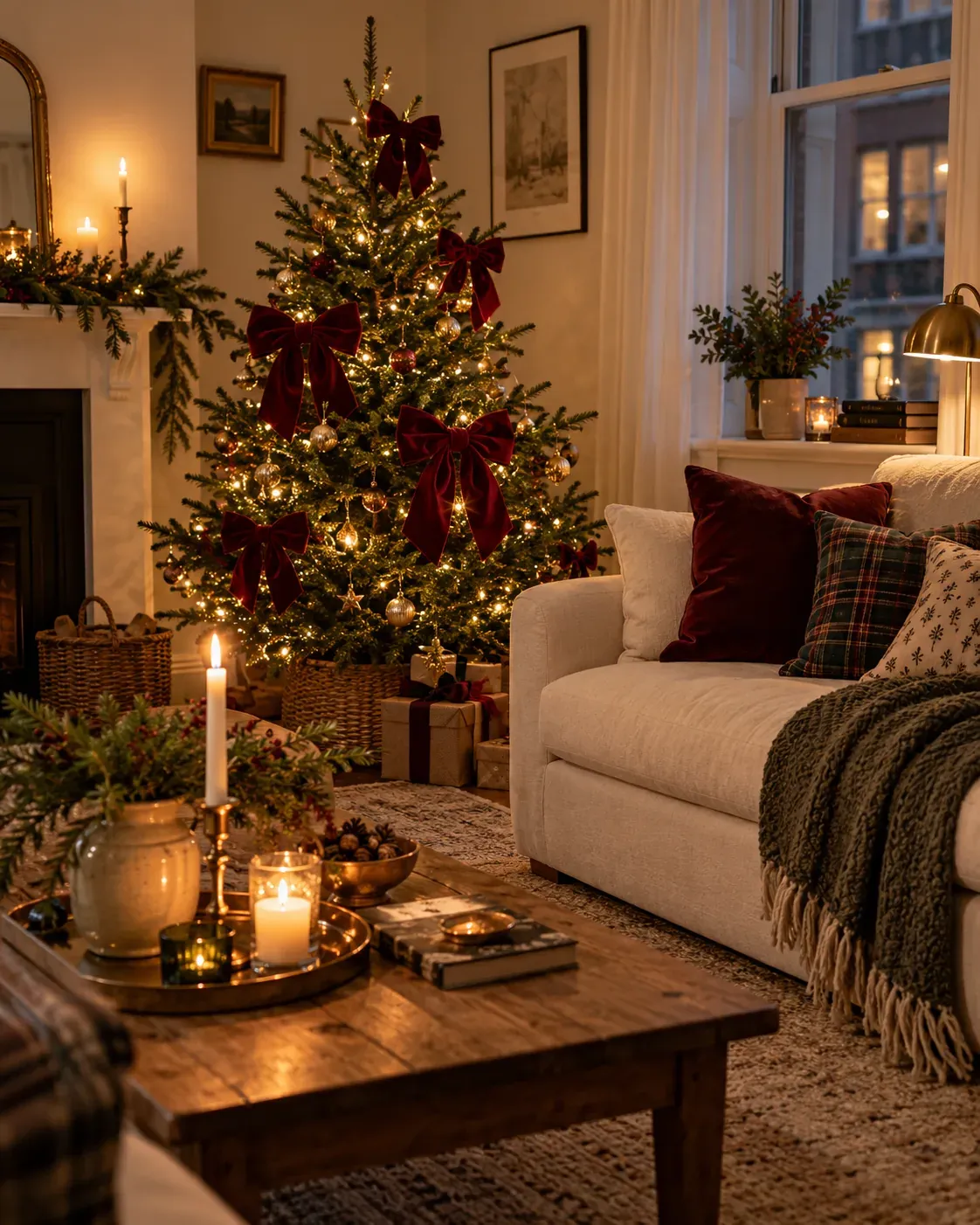
- 10. Hide a stable stand with a decorative basket
- 11. Try a small potted evergreen
- 12. Put a small tree near a window, not in its way
- 13. Let warm white lights do most of the work
- 14. Raise a mini tree on a sturdy plant stand
- 15. Mark a studio living zone with a compact tree
- 16. Use warm neutrals in a small living room
- 17. Make a greenery-and-ornament alternative
- How to Choose the Right Christmas Tree Size for a Small Apartment
- Christmas Tree Decorating Trends for 2026
- How to Make a Small Christmas Tree Look Beautiful
- Christmas Tree Mistakes to Avoid in Small Apartments
The challenge is finding a tree that lets you open the front door, reach the sofa, and use the room. Height matters, but so do branch width, the stand, and the route beside it.
These ideas range from a slim tree to arrangements that use almost no floor. Choose one that fits daily routes and off-season storage. Follow light and tree instructions; keep the setup stable and clear of exits and heat.
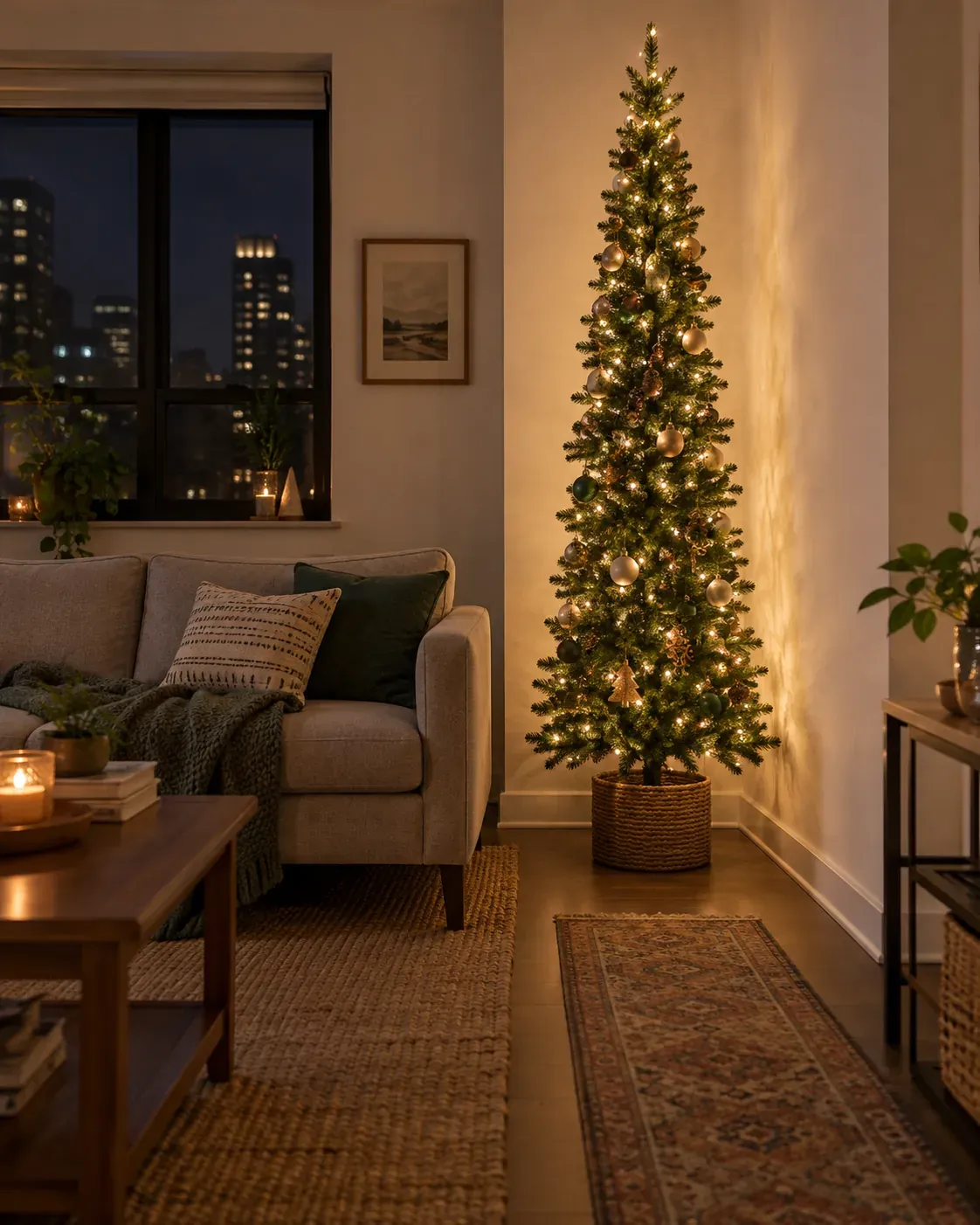
1. Give a slim pencil Christmas tree one clear wall
A pencil tree gives a tight room a full-height silhouette with less branch projection. Put it against a solid wall near a corner, where it can be seen from the sofa without occupying the kitchen route.
Measure maximum width and base, not just height. Space small ornaments through the branches. A tall pencil tree can still crowd a low ceiling or tip if its stand is weak; follow its setup guidance.
2. Use a small corner Christmas tree
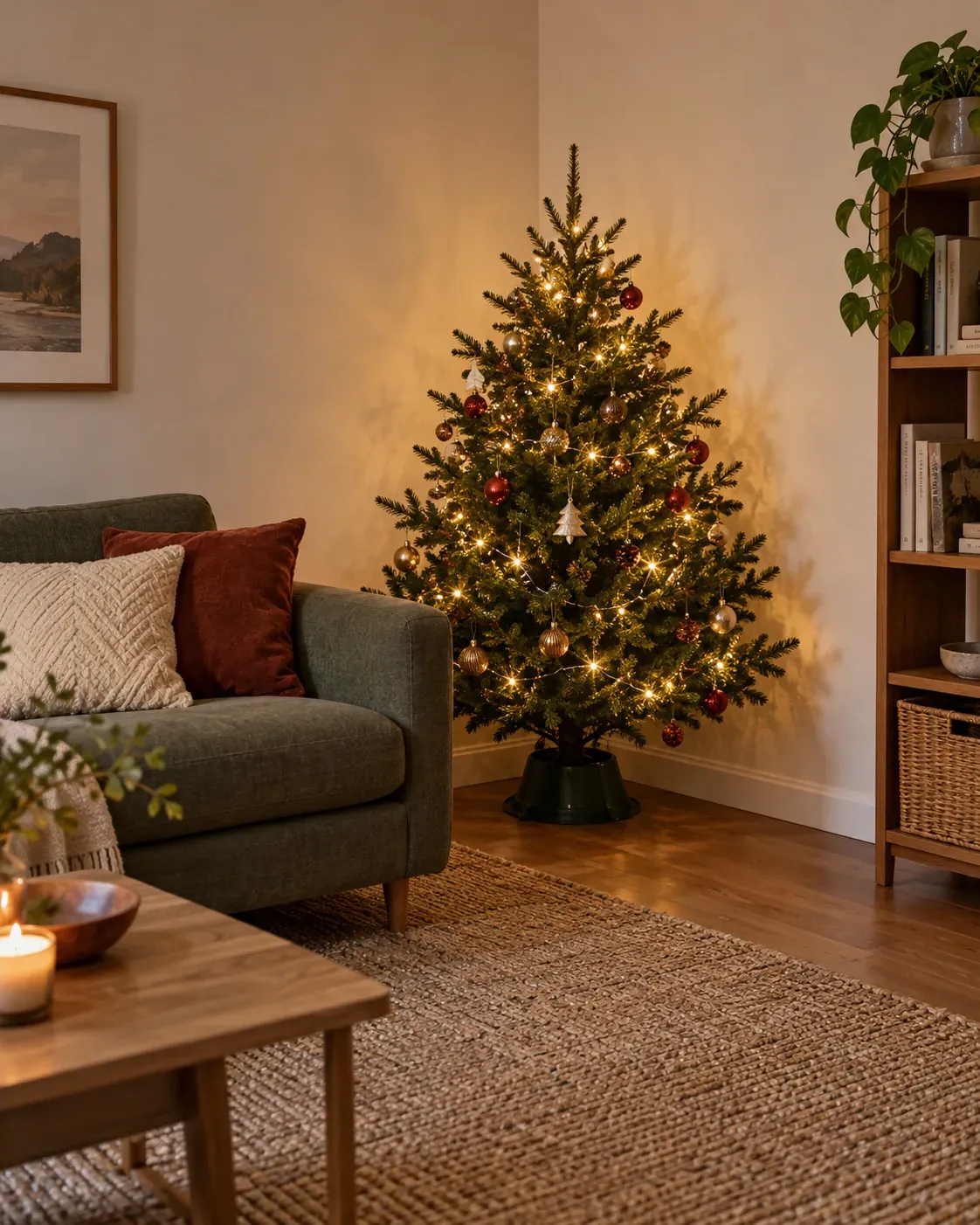
An underused corner can hold a short tree and keep the center open. Choose a corner you can approach for decorating and watering. Turn the fullest side toward the room and focus ornaments at eye level.
Check with doors open and furniture in use. Avoid a corner that crowds the sofa, catches vent heat, or blocks a window or exit. A cut tree needs a suitable water-holding stand inside any cover.
3. Put a tabletop tree on a sturdy cabinet
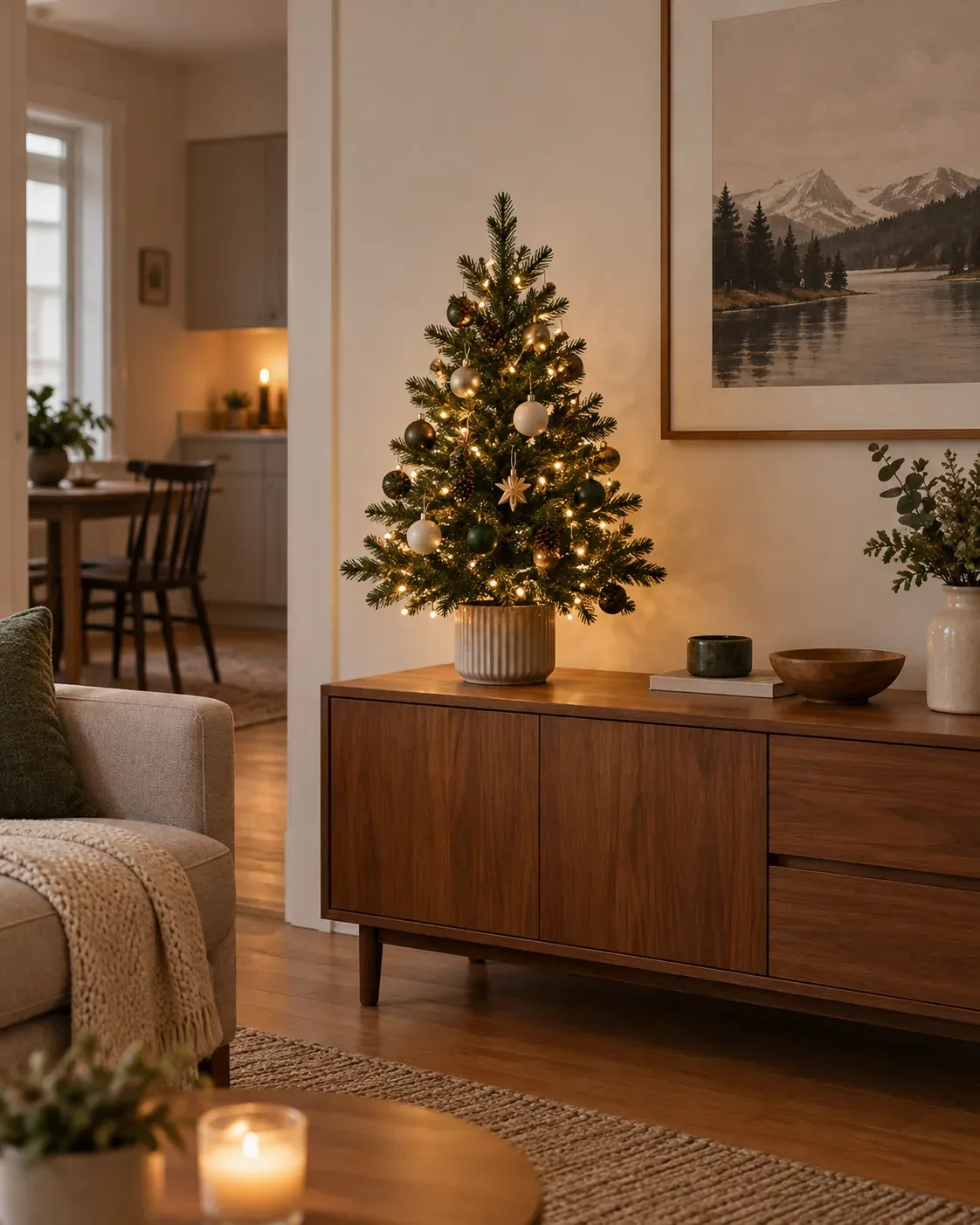
A tabletop tree adds a focal point without using floor space. Choose a stable cabinet over a narrow shelf. Its base should fit fully on the surface without blocking drawers; keep ornaments light.
Do not use wobbly furniture, a spot near heat, or a cord a pet can pull. A tabletop cut tree still needs a water-holding stand and regular checks; an artificial one is simpler when watering is awkward.
4. Consider a half Christmas tree for a flat wall
A half tree has a decorated front and flat back. It can look fuller than a pencil tree while using less depth. It suits a short wall if its base stays clear of the door route.
Follow the maker’s stand and securing instructions. Check actual projection, including branches: some half trees are wide at the base. A standard tree pushed against a wall may lean.
5. Make a lightweight wall tree
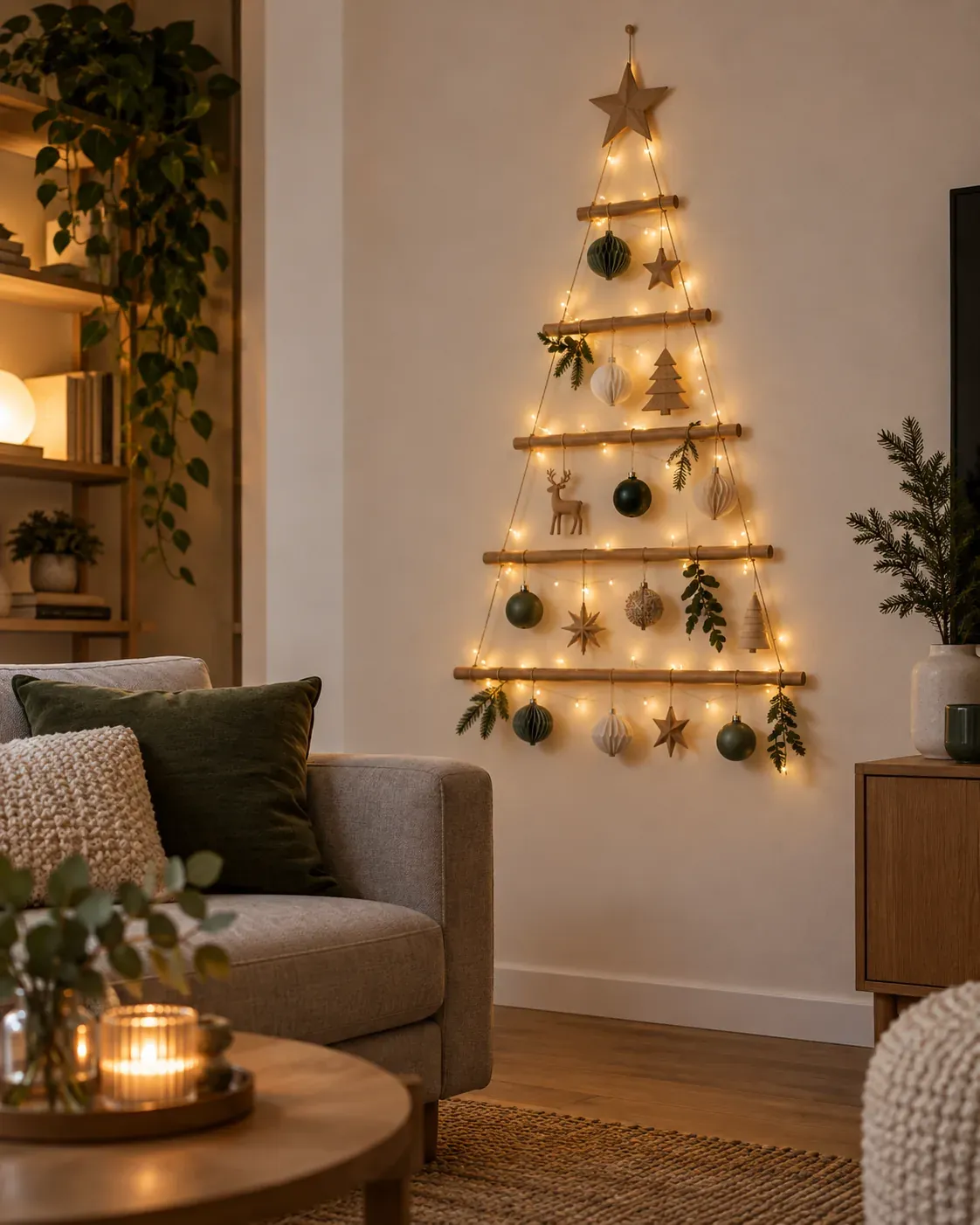
For almost no floor use, arrange lightweight dowels, greenery, or ornaments in a tree outline. A broad lower row, shorter rows above, and one small topper are enough.
Match hardware to wall and weight, and check rental rules. Removable hooks have specific load and surface limits. Route any rated lights without a trip hazard and avoid heavy ornaments over seating.
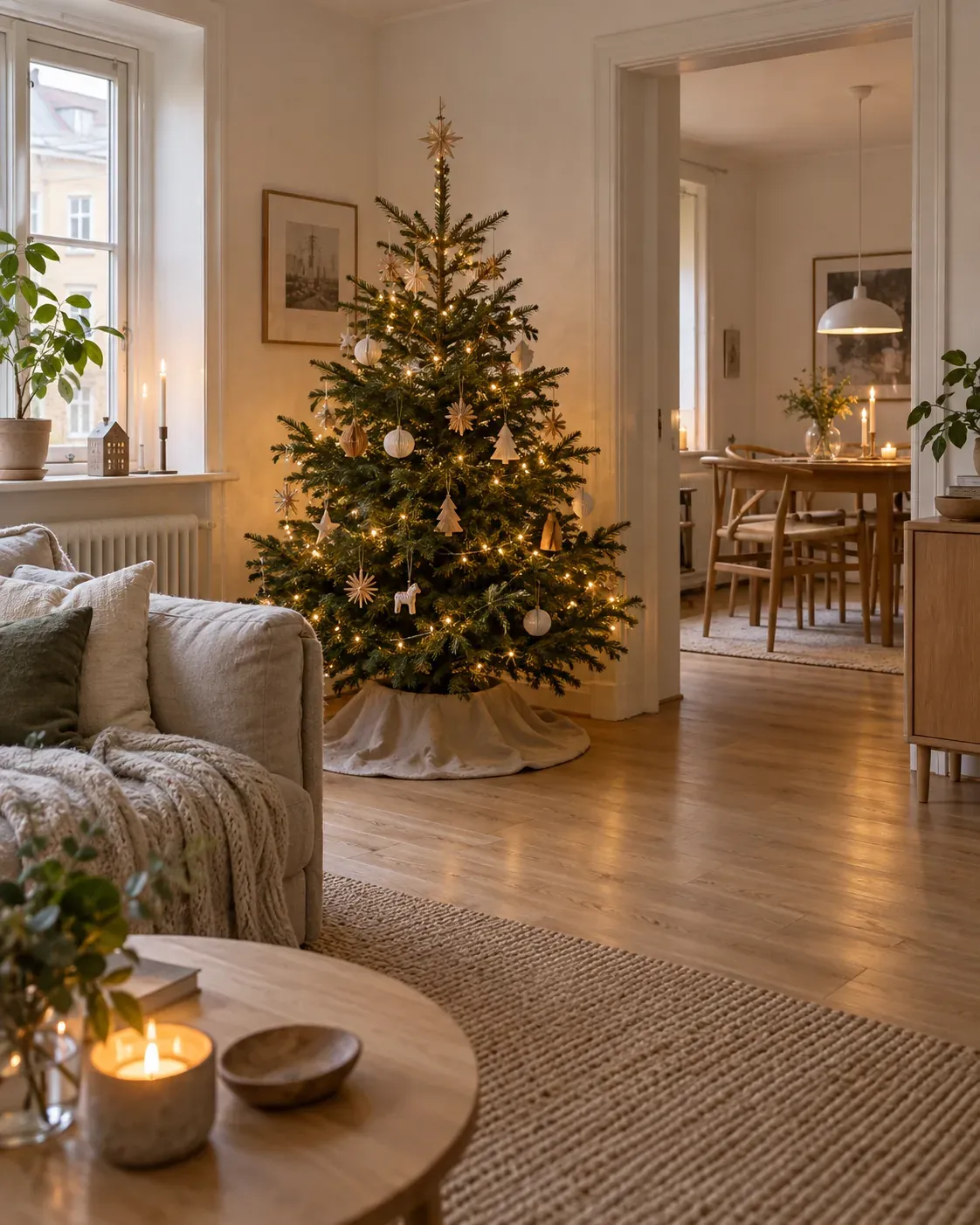
6. Keep a Scandinavian-inspired tree visually light
An airy tree with paper or wood ornaments and warm lights adds little visual weight. Repeat one or two materials in the room. A linen wrap may conceal the stand without impairing stability or watering.
This approach suits rooms already full of colorful books or art. The spaces between ornaments are part of the look. Use unbreakable decorations within reach of children or pets.
7. Try a mini tree on an existing side table
A mini tree can share a side table with a lamp if the table is broad and stable enough for both. Place the tree toward the wall, keep the lamp and switch accessible, and avoid draping lights over either fixture. A compact cluster of ornaments at the front makes the little tree look complete from the sofa.
The advantage is that you can use furniture you already own. The limitation is the table’s real load capacity and daily use: if it normally holds drinks, books, or a remote, do not crowd those out. A tiny unlit artificial tree may be the best fit for a narrow table.
8. Tuck a narrow tree beside the sofa
The gap beside a sofa can be a good tree location if it is not the route to a window, door, or outlet. Choose a tree whose widest branches stop short of the sofa arm so people can sit without brushing ornaments. A slim base cover and warm white lights can make it feel integrated with the seating area. Repeat a color from the cushions or throw in a few ornaments.
Measure the gap with the sofa pulled into its normal position. Leave access to a side table or lamp you use daily. This arrangement fails when the tree becomes a barrier to getting up or when furniture presses on the branches; move it to a corner instead.
9. Use burgundy velvet bows as the main decoration
On a small tree, a handful of burgundy velvet bows can provide more visual rhythm than a large box of mixed ornaments. Tie or clip them at different heights, with one near the upper third and the rest following the tree’s natural branch spacing. Add a few matte cream ornaments and warm lights; the burgundy will carry the color story.
Choose ribbon pieces that are proportionate to the tree rather than one oversized bow on every branch. Keep loose ends short around pets and children, and avoid placing fabric against bulbs or heat. If you want the same detail elsewhere, our Christmas bow decorating ideas show ways to repeat it without filling the room with another large display.

10. Hide a stable stand with a decorative basket
A woven basket can soften the base of a small artificial tree, but the basket is a cover, not the support. Set the tree in the stand supplied or approved by its maker, then position an open-bottom basket or a suitable cover around it without changing the stand’s footing. For a cut tree, preserve access to the water reservoir and protect the floor from drips.
This works best with short trees whose stand fits comfortably inside the cover. Check the tree’s stability before decorating, particularly where pets or children may bump it. Avoid a tall narrow basket that makes the trunk look top-heavy or prevents you from seeing a water level.
11. Try a small potted evergreen
A living potted evergreen offers real foliage in a small footprint, but it is a plant with care needs rather than an artificial tree that can stay unchanged for weeks. Choose a species suited to your climate and future plans. Check the soil, drainage, light, and indoor temperature directions for the exact plant. A waterproof tray beneath the pot protects furniture or flooring.
Penn State Extension’s living-tree guidance distinguishes container-grown trees from heavier balled-and-burlapped trees and advises keeping the root zone moist without standing water. Some outdoor evergreens tolerate only a short warm indoor display before returning to cooler conditions. If you cannot provide appropriate care or a place afterward, an artificial tabletop tree may be more practical.
12. Put a small tree near a window, not in its way
A window-side tree can be enjoyed from indoors and from the street. Place it to one side of the window rather than directly across the sash, and keep curtains, blinds, and the opening itself usable. A slim tree with lights reads well against evening glass; restrained ornaments avoid a busy silhouette.
Do not set a live tree against a sunny pane or heat vent simply for the view. Check that cords reach an appropriate outlet without crossing a path, and that the tree does not interfere with emergency window access where applicable. If the window area is the only clear route, choose a tabletop display elsewhere.
13. Let warm white lights do most of the work
A small tree with warm white lights and only a few ornaments can feel complete. Distribute the lights through the branches rather than wrapping a thick bright band around the outer edge. Keep the wire tucked where it will not snag, and choose a small number of ornaments that remain visible after dark. This is a good option for a rental where extra seasonal storage is limited.
Use lights intended for the tree and location, inspect cords and connections, and follow the maker’s limits on connecting strands. NFPA’s Christmas tree guidance recommends turning tree lights off before leaving home or going to bed. Avoid candles on or near the tree.
14. Raise a mini tree on a sturdy plant stand
Height can give a tiny tree presence without requiring a larger one. A broad, low plant stand can lift a lightweight artificial tree beside a sofa or in a bare corner. Choose a stand rated for the combined weight and set the tree squarely on its top; the pot or base must not overhang. A simple basket underneath can hold a folded throw, not serve as ballast.
This is unsuitable for a wobbly stand, a heavy living tree, or a place where children or pets can pull the arrangement over. Test the setup before adding ornaments. If it feels precarious, use a sideboard or the floor instead.
15. Mark a studio living zone with a compact tree
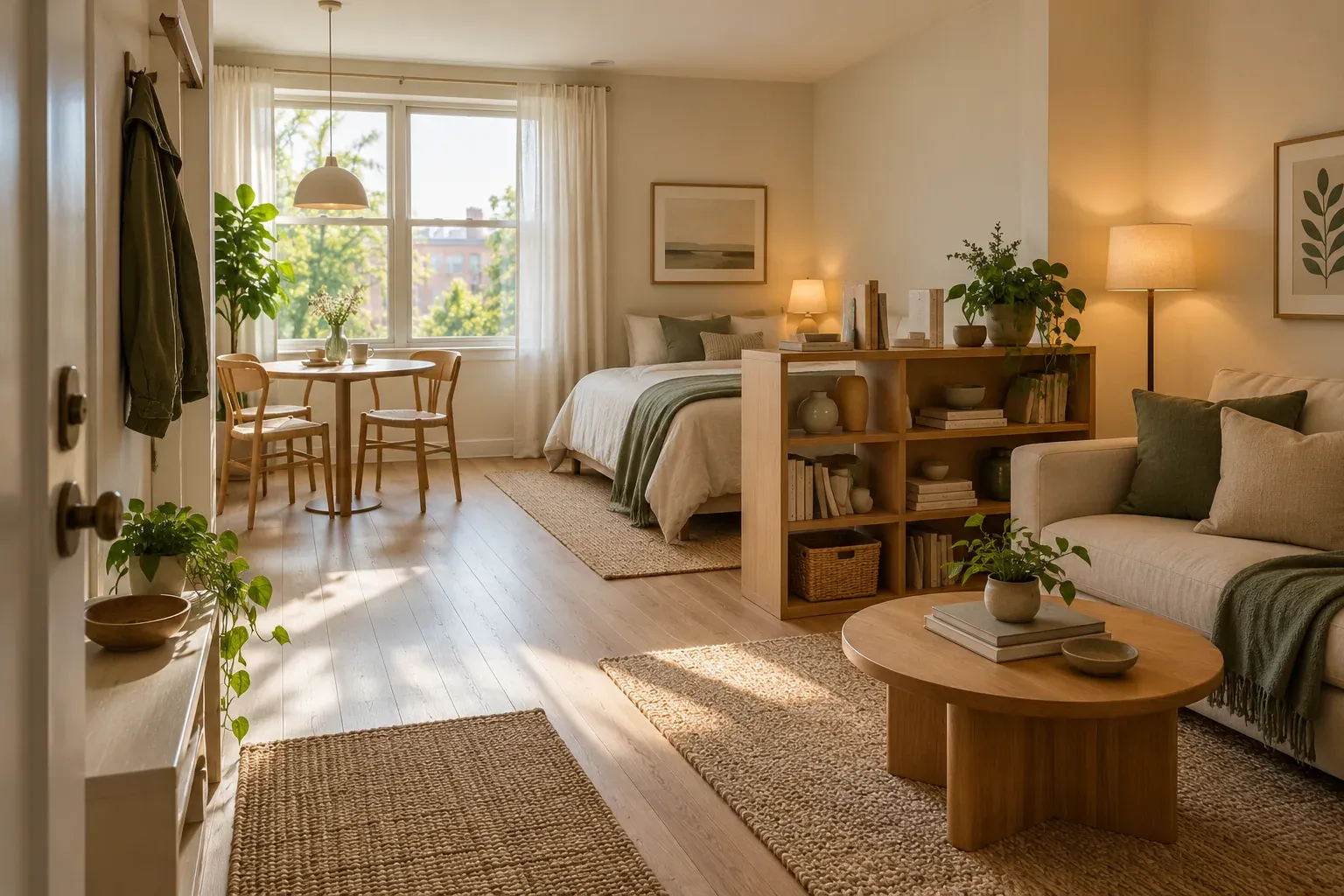
In a studio, a tree should reinforce a zone rather than divide an essential route. Put a compact tree beside the sofa or at the edge of the living area, where its lights signal a gathering spot without reaching into the sleeping or dining area. Keep the base modest and choose ornaments that coordinate with the existing room colors.
Try the placement with the dining chair pulled out and the bed in use. If the tree blocks either activity, move it onto a cabinet or use the wall version. Our studio apartment layout ideas explain how to keep overlapping functions clear in one room.
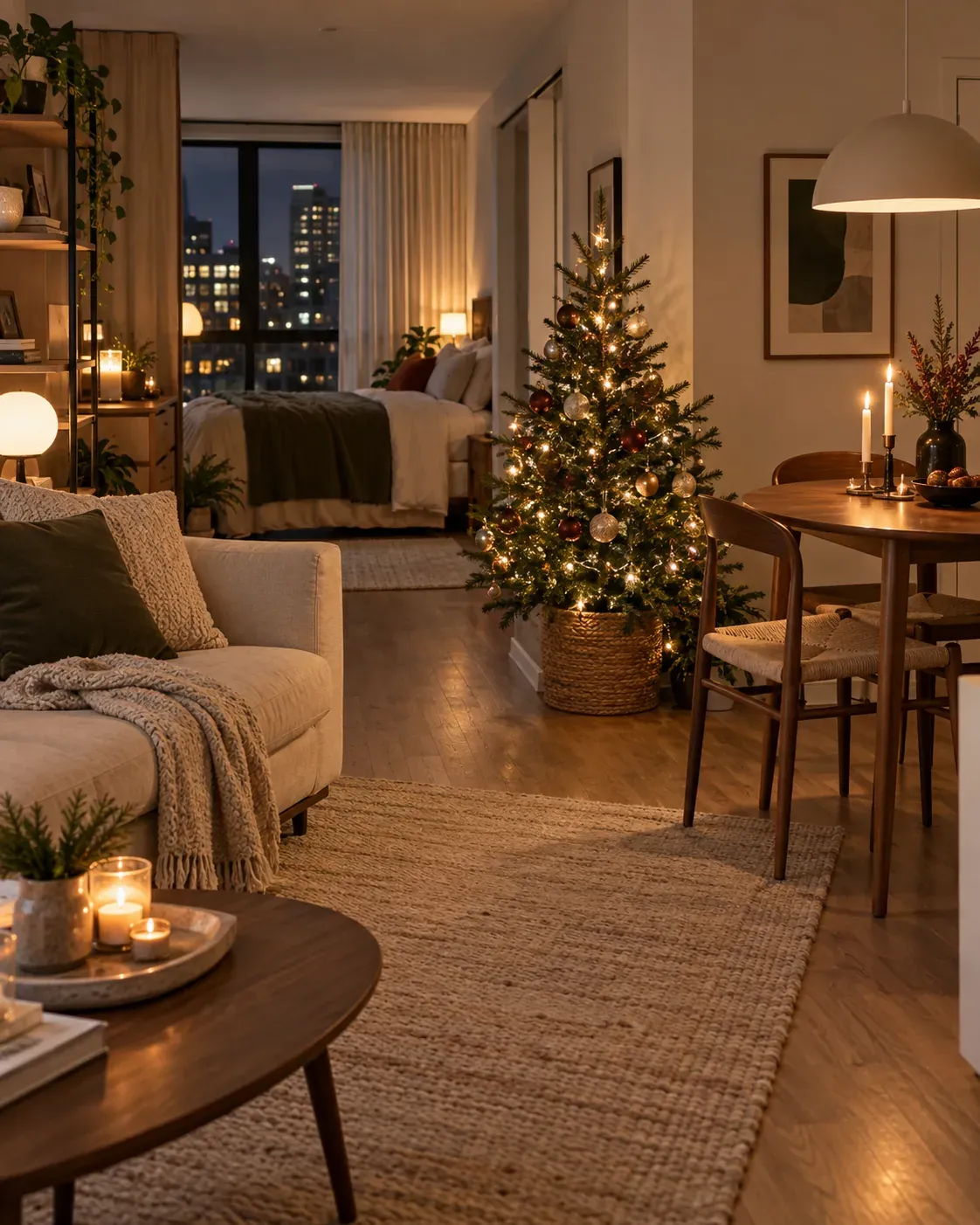
16. Use warm neutrals in a small living room
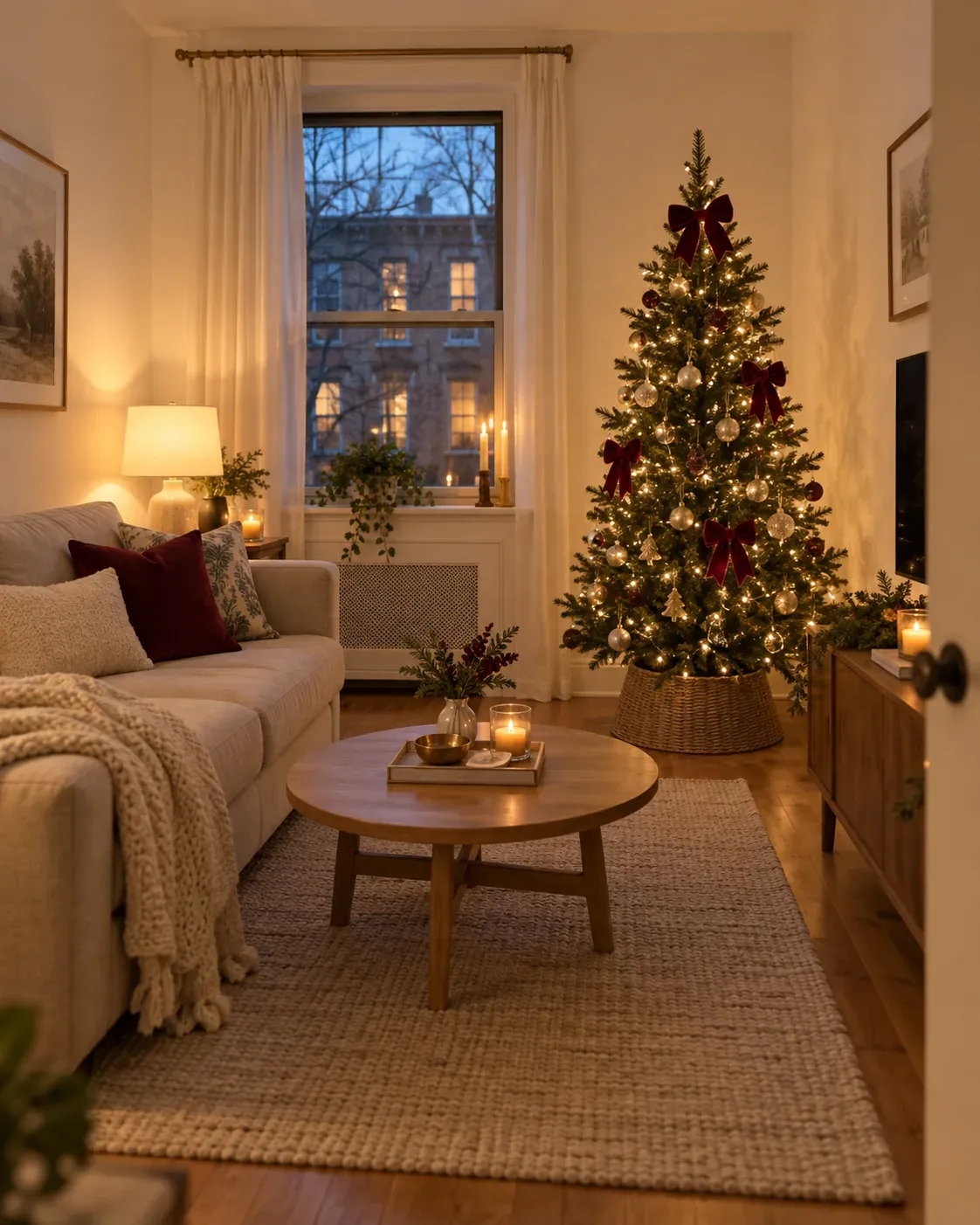
Ivory, champagne, pale wood, and a little muted metal can make a compact tree feel connected to a beige sofa and neutral rug. Choose one finish as the main accent—perhaps matte ivory ornaments—then use the others sparingly. A light-colored base cover keeps the tree from reading as a heavy dark block in the corner.
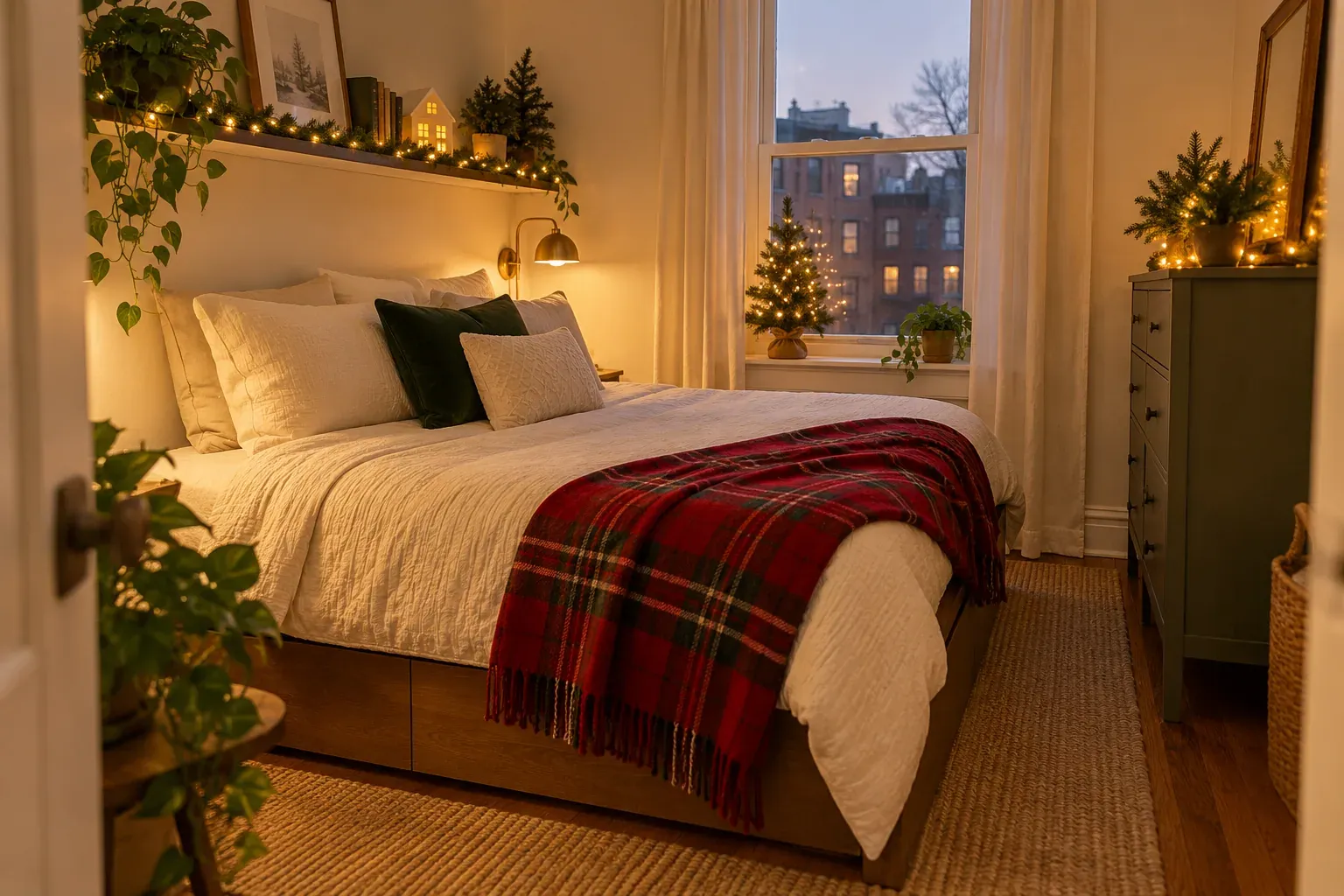
Neutral does not mean invisible. Leave enough contrast between ornament and branch, and vary texture rather than adding more colors. If the living room already has festive bedding or soft furnishings nearby, the Christmas bedroom decor guide offers ideas for carrying a calm seasonal palette through the apartment.
17. Make a greenery-and-ornament alternative
If there is no room for a standing tree, place a few evergreen branches in a stable vase on a cabinet, or arrange a modest garland around a mirror or shelf with one cluster of ornaments. The aim is a recognizable seasonal focal point that does not claim floor space. Use artificial greenery if you need a display that stores easily and requires no watering.
Keep greenery and fabric away from heat sources, electrical fixtures, and candles. Mount any wall display according to the weight and surface requirements, especially in a rental. Do not drape ornaments across a door or over a seat where they can be pulled down.
How to Choose the Right Christmas Tree Size for a Small Apartment
Measure the proposed spot at floor and furniture height. Note the tree’s widest branch spread, the stand or basket cover, the ceiling, and the route people take past it. Tape the footprint onto the floor and live with it for a day. Open doors, pull out chairs, and reach outlets and windows. A tree that technically fits in an empty room may not fit its everyday use.
Choose a tabletop tree when floor space is the limiting factor, a pencil tree when you have height but little width, and a compact traditional tree when the room has an open corner with enough depth. If you store the tree after Christmas, check the box dimensions too. Avoid buying a taller tree to compensate for poor placement; a smaller one set in a visible spot can do more.
Christmas Tree Decorating Trends for 2026
For 2026, velvet bows and nostalgic ornaments offer two useful directions for small-space decorating because a few pieces can carry a theme. Primark’s 2026 holiday collection features red velvet bows and playful nostalgic motifs; Hallmark’s 2026 trend report likewise discusses memory-filled decorations. These are examples of current collections, not a requirement to replace decorations you already own.
Natural textures, paper ornaments, warm lighting, and a coordinated palette also suit compact trees. Choose the direction that works with your room and storage: burgundy bows for a little drama, a few keepsake ornaments for personality, or pale wood and ivory for a lighter look. One clear idea usually reads better than several competing themes on a small tree.
How to Make a Small Christmas Tree Look Beautiful
Start with the tree’s shape. Fluff an artificial tree according to its instructions, or turn the best side of a real tree toward the room. Add lights evenly, then place the largest ornaments first with space between them. Fill a few gaps with smaller pieces, stepping back often. A tree does not need ornaments on every branch.
Repeat two or three colors and vary finish—matte, soft sheen, natural texture—to add depth. Let the top decoration match the scale of the tree. Conceal the stand only after confirming it remains level and accessible. A small tree looks most considered when its surrounding table or floor is not crowded with unrelated objects.
Christmas Tree Mistakes to Avoid in Small Apartments
The main mistake is choosing a tree by height alone. Wide lower branches, a broad stand, and a bulky base cover can consume the very floor you meant to keep. Do not block doors, exits, vents, windows that need access, or the route around seating. Skip unstable plant stands and wall displays that exceed their mounting limits.
Follow tree and light instructions, inspect electrical accessories, and keep the display away from heat. NFPA recommends keeping trees at least three feet from heat sources, using lights as directed, and ensuring the tree does not block an exit. For a cut tree, check its water daily and remove it when dry. Keep fragile or tempting ornaments above the reach of children and pets, and choose a stable setup before thinking about the ribbon.
Looking for more ideas? Browse our seasonal decor stories.
Save to Pinterest